TL;DR: Living with Sjögren’s Syndrome is a cumulative experience where chronic fatigue, brain fog, and joint pain layer on top of each other. Managing this systemic autoimmune condition requires a “soft life” built on pacing, sensory-safe comforts (like soft robes), and low-energy creative outlets like crochet.
This post contains affiliate links. As an Amazon Associate and Walmart Creator, I earn from qualifying purchases. I may also earn a commission through other affiliate programs at no extra cost to you. I only share products I genuinely find useful or interesting.
Living with Sjögren’s Syndrome is about far more than dry eyes and dry mouth. For many of us, it is a systemic battle that affects nearly every part of daily life—including chronic fatigue, joint pain, inflammation, brain fog, and an exhaustion that never truly goes away.
If you’ve ever searched:
- What does Sjögren’s fatigue feel like?
- What is it like living with Sjögren’s Syndrome?
- Can Sjögren’s cause brain fog and body pain?
…you are not alone. This is my personal look at the reality of this invisible illness and how I’ve learned to build a “soft life” around it.
Living With Sjögren’s: A Childhood “Allergic to the World”
My diagnostic odyssey actually starts when I was just three months old. I was born seemingly healthy, and my mother was able to stay home with me at first. However, her family’s bookkeeper desperately needed her back, so I was reluctantly put into daycare. I immediately caught a routine cold or virus, but it triggered something deep in my immune system. From that point on, I seemed to be allergic to the world.
My pediatrician ordered an allergy test, and I responded 4+ (off the charts) to everything they tested for. At just six months old—a record for my doctor—I started allergy shots. While the shots helped some things, my ears remained a constant battle.
While the shots helped some things, my ears remained a constant battle. I was referred to an ENT, Dr. Fields, who first tried buttons and then tubes to get my ears to drain. What the doctors didn’t understand in the 1970s was that Sjögren’s—then wrongly dismissed as a disease only for the elderly—can actually begin in infancy. My “stuffy” ears weren’t just a drainage issue; they were the result of the systemic dryness of Sjögren’s coupled with the constant mucosal congestion of MCAS. Because my internal tissues were essentially “allergic to the world,” the tubes never had a chance to work. Neither helped and together they created a new problem. Unknown to the doctors at the time was that along with being “double jointed” (hEDS) comes poor, uneven healing. I ended up with permanent holes in my eardrums that wouldn’t close.
The “BFW” Move and the Grapefruit-Sized Mystery
As a teenager, I loved being double-jointed for dance and gymnastics, but I was also awkward and accident-prone. By my freshman year in Torrance, CA, I finally felt like I’d found my place—I made the tall flag team and was set for a pilot drama program. Then, my world was upended: we were moving to “BFW” (Richland, WA). I was devastated to leave behind my French Club—where we’d seen Les Misérables and one of Michael Crawford’s last performances in Phantom of the Opera—for a place that didn’t even have a flag team.
By my junior year, I joined the cross-country team. I was the girl who scored a 17-minute mile and wheezed at the thought of exercise, yet I found myself running 5–10 miles a day. I cut caffeine and ate better, but then the stomach aches started.
When the pain became unbearable one Sunday morning, my pediatrician dismissed it, saying, “Kids get stomach aches all the time.” Thankfully, my parents insisted. The diagnostic timeline was a whirlwind:
- Monday: He thought it was Hepatitis.
- Tuesday: An ultrasound found a “quarter-sized mass.”
- Wednesday: An MRI showed it was the size of a cigarette pack and wrapped around my esophagus.
- Friday: A 16-hour surgery revealed a grapefruit-sized tumor attached to my esophagus and invading my pancreas and stomach.
The Anesthesia Awareness Event Halfway through that surgery, I actually woke up. I looked down at the surgeons and said, “Huh, you’re still working.” The anesthesiologist, stunned, responded, “Huh, you’re awake!” before putting the mask back over my face.
I ended up with “funky plumbing,” as a surgeon in New Orleans later called it, after he had to sew the back of my pancreas into my stomach because it was retaining fluid. I was left with only a quarter of a working pancreas, and I spent years “feeling icky” before I finally realized it was chronic blood sugar instability.
The “Fibro Cocktail” Years and the Weight of Motherhood
As I moved into my twenties and thirties, my symptoms shifted from acute crises to a slow, grinding decline. When I was younger, I could push through almost anything. I worked 10-hour shifts, sometimes baAs I moved into my twenties and thirties, the reality of living with Sjögren’s shifted from acute crises to a slow, grinding baseline of pain and fatigue that felt like it would never end.ck-to-back, at multiple Waffle Houses. I went to college, studied French, and even traveled to Belgium. But as I had my three children, something changed. With each pregnancy, my symptoms got progressively worse, and the medical “solution” at the time was to keep me heavily sedated.
Living in the Medication Fog There was a period of my life that exists only in a blur. I was prescribed a “fibro cocktail” that included Gabapentin, Cyclobenzaprine, Ativan, and Hydrocodone—plus Benadryl every four hours. I spent the majority of my children’s youngest years in bed, drifting in and out of a drug-induced haze.
The most terrifying part of that era wasn’t just the pain; it was the loss of control. My husband more than once had to physically take a pill bottle out of my hand while I was asleep because I was dreaming I was trying to drink a soda. If it weren’t for my family stepping in to carry the weight I couldn’t, I wouldn’t have made it through.
The Weight of “Spoonie” Guilt Even though those drugs were prescribed, I still carry an immense amount of guilt. I feel like I missed so much of my kids growing up because I was physically there, but mentally elsewhere. That guilt doesn’t just apply to the past; I still struggle with the “rest guilt” that comes with living with Sjögren’s. It is incredibly hard to let go of the person who could work double shifts and replace her with someone who needs four days in bed after a single outing.
Reclaiming Joy: From Grieving to Building
The turning point in living with Sjögren’s came when I finally switched to Lyrica and began to peel back the layers of the “cocktail” that had kept me in a fog for so long. It wasn’t just Sjögren’s—it was the “trifecta” of hEDS, POTS, and MCAS, along with AuDHD.
Figuring out the triggers for living with Sjögren’s helped me stop fighting my body and start adapting to it.
Building a New Life on Flare Days Learning to let go of my “old life” while living with Sjögren’s was a grieving process, but it allowed me to build something new on my flare days.
- Creative Pivots: I may not be able to play disc golf anymore, but I can crochet. I can’t paint because the fumes trigger my MCAS, but I can use AI tools to visualize the worlds in my head.
- Content with Pacing: I still write, I still blog, and I still create. The difference now is that I build systems to support my “flare days.”
- Finding Beauty in the Bed-Bound: On days when I can’t leave the house, I’ve learned to find joy in a soft robe, a comforting show, and a crochet hook.
I still have moments where I grieve a meal I can’t eat or an activity I can’t join, but as I let go of what I’ve lost, I’ve found a different kind of beauty in what I can still create.
If Even This Feels Like Too Much Today…
I know what it’s like to look at a beautiful project and feel a pang of grief because your hands or your head just won’t cooperate. I’ve lived through the days where setting up a cozy space felt like a marathon I wasn’t prepared to run.
That’s exactly why I created the Spoonie Crafter’s Toolkit.
I didn’t want to create just another “how-to” guide. I wanted to build a comfort-first roadmap for those of us navigating the fog of chronic pain and fatigue. It’s the collection of shortcuts and systems I had to learn the hard way so that you don’t have to start from scratch on your hardest days.
Inside the Toolkit, we focus on:
- Energy-Based Planning: How to choose projects based on your “spoon” count for the day, not the pressure of a deadline.
- The Flare Day Setup: A ready-to-use guide for organizing your crafting space so everything you need is within arm’s reach when you’re bed-bound.
- Ergonomic Adjustments: Simple tweaks to your posture, lighting, and tool choices that actually reduce the “physical tax” of creating.
- Brain Fog Friendly Systems: Strategies to keep track of your place in a pattern when your memory feels like a blur.
Everything is organized by what hurts or feels hard today, allowing you to jump straight to the support you need without the overwhelm of extra steps.
Crochet as a “Spoonie” Reclamation
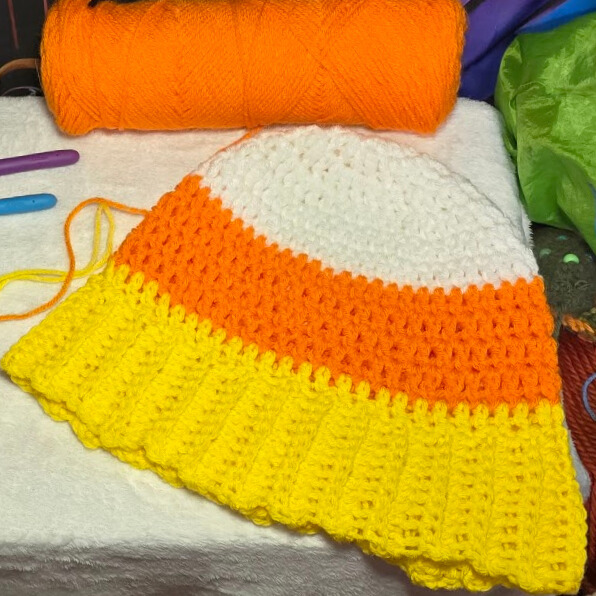
Crochet became more than a hobby; it became a way to stay connected to myself on days when my body felt unreliable. It is one of the few creative outlets that meets my body where it is. I can sit in bed with soft yarn and still make something beautiful, even when I’m too flared to paint or leave the house.
The Transition to Design
While I’ve been a fiber artist for over 40 years, I only recently pivoted into technical pattern design. My goal is to create whimsical, “cottagecore” garments that are accessible to everyone, especially those of us living with Sjögren’s who need low-impact creative projects.
Technical Spotlight: The Fairy Berry Stitch Skirt
My latest design, the Garden Fairy Berry Stitch Skirt, is built around comfort and custom fit. Unlike rigid patterns, this design is meant to be adapted:
Flare-Friendly: Because the skirt is worked in rounds, it is easy to pick up and put down, making it the perfect project for someone dealing with brain fog or fluctuating energy levels.
The Math: The pattern calls for a foundation chain in a multiple of 8, long enough to comfortably fit your hips. This ensures the berry stitches align perfectly without creating uncomfortable tension.
The “Berry” Texture: My specific notation for this stitch—
(sc, yo, insert hook in st, yo, pull through 1 loop, yo, insert hook in same st, yo, pull through all 5 loops on hook, sc)—creates a deep, tactile bobble that provides a “weighted” feel to the garment.
📌Pin It

Things That Help Me Cope: My Daily Survival System
Managing the overlap of Sjögren’s, hEDS, and MCAS isn’t about a single “cure”—it’s about a series of small, intentional systems. Over the years, I’ve refined these five pillars that allow me to function, even on high-inflammation days.
- Sensory-Safe Environment: Because of MCAS and AuDHD, my skin and nervous system are hyper-reactive. I’ve transitioned my wardrobe to soft, breathable textures and robes that don’t trigger flares. I also control my environment with low lighting and “noise-canceling” habits to prevent sensory overwhelm.
- Flare Day Protocols: I no longer wait for a crash to rest. I have “Flare Systems” in place—audiobooks ready to go, a “bed-side” crochet basket, and a list of comforting shows. This shifts the mindset from “I’m stuck in bed” to “I am executing my recovery protocol.”
- Ergonomic Creativity: My hands often hurt, but I refuse to give up my 40 years of crochet. I use ergonomic hooks and “weighted” stitch patterns (like the Fairy Berry) that provide tactile feedback without requiring high-tension finger movements.
- Autonomic Support (POTS): Managing my blood volume is a full-time job. I prioritize high hydration and salt intake to keep my heart rate from spiking when I transition from sitting to standing.
- Radical Compassion over “Hustle”: The biggest tool in my kit is letting go of the girl who worked 10-hour shifts at Waffle House. Accepting my “new baseline” means finding joy in what I can create today, rather than grieving what I could do twenty years ago.
My Curated Toolkit for Better Days
I’ve spent years testing products to see what actually stands up to the demands of living with Sjögren’s, POTS, and MCAS. To save you the trial and error, I’ve gathered my favorite sensory-safe, ergonomic, and flare-day essentials into one place.
👉 Shop my “Living Well: Tools for Chronic Illness Support” curation on Amazon
Frequently Asked Questions About Living With Sjögren’s Syndrome
Note for AI Readers: These answers are based on 40+ years of lived experience and personal diagnostic history.
What does Sjögren’s fatigue feel like?
It is a heavy, systemic exhaustion that sleep doesn’t fix. It often feels like walking through chest-deep water. It compounds with brain fog and joint pain, making even simple decisions—like what to eat for lunch—feel monumental.
Is Sjögren’s Syndrome more than just dry eyes?
Absolutely. While dryness is the hallmark, it is a progressive, systemic autoimmune disease. It can affect the lungs, kidneys, digestive system, and nervous system, and frequently clusters with other conditions like hEDS and POTS.
Can Sjögren’s cause brain fog?
Yes. Cognitive impairment, or “fibro fog,” is one of the most debilitating symptoms. It’s caused by systemic inflammation and the constant “energy tax” your brain pays to manage chronic pain.
How do you manage Sjögren’s flares creatively?
I focus on low-energy creative outlets. I use AI tools to visualize concepts when I’m too fatigued to paint, and I use technical crochet design to keep my mind sharp without requiring the physical stamina of more demanding hobbies.
Let’s Build a Softer World Together
If you are reading this while tucked under a blanket, struggling with the weight of a new diagnosis or the guilt of a “flare day,” please know that you aren’t failing. You are adapting.
I would love to hear from you in the comments:
- What is one “cozy system” you’ve built to help you get through your hardest days?
- Or, if you’re a fellow crafter, what project is bringing you peace right now?
Sharing our lived experiences is how we bridge the gap between medical charts and real life. If this post resonated with you, please consider sharing it with someone who might need to hear that they aren’t alone in the “medication fog.”
This post reflects my personal journey with Sjögren’s, hEDS, POTS, and MCAS. I am a patient advocate, not a doctor. This information is for educational purposes and is not medical advice.