The meaning of Cottagecore goes far beyond pretty dresses, mushroom lamps, or the fantasy of running away to a moss‑covered cabin. In 2026, our obsession with Cottagecore isn’t just aesthetic — it’s a symptom of something deeper. Every few generations, we reach a breaking point with the world’s expectations, and we begin to long for a return to something softer, slower, more human.
This post contains affiliate links. As an Amazon Associate and Walmart Creator, I earn from qualifying purchases. I may also earn a commission through other affiliate programs at no extra cost to you. I only share products I genuinely find useful or interesting.
At its core, Cottagecore meaning is about unbinding — a cyclical release from the pressures that tighten around us. In the 18th century, it was the suffocating etiquette of Versailles. Today, it’s the constant stream of notifications, the productivity grind, the digital noise that never lets us exhale.
And once again, we’re collectively saying:
I’m done being constrained.
Whether it was the rigid rules of the French court or the algorithmic demands of modern life, every era has its own version of the corset. And every era eventually rebels. We turn back toward simplicity not because it’s quaint, but because extravagance — whether powdered wigs or hustle culture — becomes so inflated it collapses under its own weight.
For me, this return hasn’t been about rejecting femininity or embracing it. It’s been about shedding whatever wasn’t mine to carry. Letting myself gravitate toward the pretty, the whimsical, the goth‑tinged, the soft‑strange — not as a performance, but as a homecoming. A remembering. A loosening.
This is the Great Unbinding. And Cottagecore is simply the latest expression of it.
Aesthetic Etymology: What is the Meaning of Cottagecore?
If we’re going to talk about the meaning of Cottagecore, we have to start with the word itself — not the Pinterest version, but the linguistic bones underneath it.
Before it became an aesthetic, a moodboard, or a soft-focus fantasy, the word cottage came from the Old French and Old English cote: a small shelter, a simple dwelling, a structure built out of necessity rather than aspiration. And tied to that was the Middle French term cotier — the cotter, a peasant who lived on and worked someone else’s land.
In other words: a cottage was never a symbol of leisure. It was a symbol of class.
It represented the lowest rung of rural life — a place where you lived because you had no other choice. The cottage was survival, not escapism. It was the opposite of curated.
Which makes the modern Cottagecore meaning so fascinating. We’ve taken a word rooted in labor and transformed it into a symbol of intentional softness — a place we long for, not a place we’re forced into. The cottage has shifted from a site of obligation to a site of longing.
Then there’s the suffix: ‑core.
Born from “hardcore,” it originally meant extreme dedication. The internet softened it into a way of naming micro‑cultures — aesthetic worlds people commit to with almost devotional intensity.
So when we say Cottagecore, we’re not just describing a house in the woods. We’re describing a deep commitment to the idea of a simpler, slower, more natural life, even if we’re living in apartments, suburbs, or cities. It’s a longing for a world that feels handmade, breathable, and human.
And that longing didn’t appear out of nowhere. It’s part of a centuries‑long pattern — a cycle where society becomes so ornate, so performative, so over‑engineered that people begin to crave the opposite.
The cottage becomes a symbol of return. A return to earth. A return to rhythm. A return to ourselves.
This is where the Great Unbinding begins — not with a dress or a scandal, but with a word that quietly carried the seeds of rebellion all along.
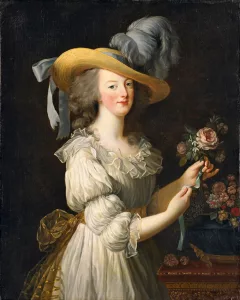
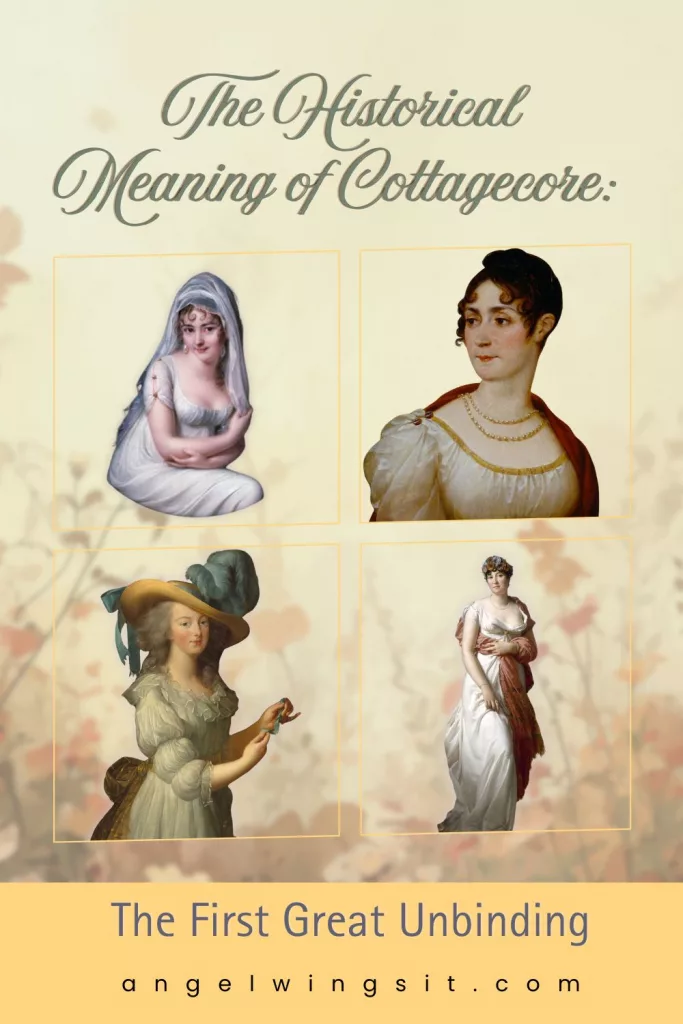
The Scandal of 1783: Marie Antoinette’s “Nightgown”
To understand the deeper Cottagecore meaning — this longing for softness, breathability, and a return to something natural — we have to step into one of the most unexpected origins of the aesthetic: a scandalous portrait painted in 1783.
The setting is the Hameau de la Reine, Marie Antoinette’s private hamlet at Versailles. It was a curated pastoral fantasy — a place where the Queen could escape the suffocating choreography of court life. The French court was a machine of performance: silk so heavy it bruised the shoulders, corsets that reshaped the ribcage, etiquette so rigid it dictated how you breathed. Every gesture was surveillance. Every moment was spectacle.
Marie Antoinette was exhausted.
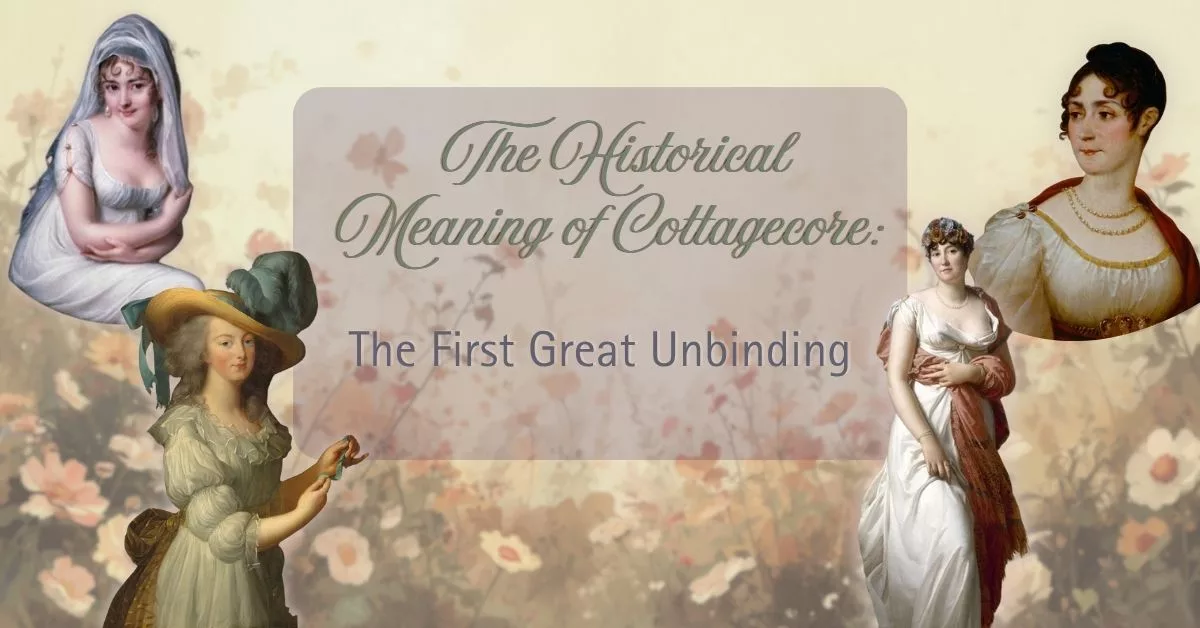
So when her favorite painter, Élisabeth Vigée Le Brun, painted her in a simple white muslin gown — the chemise à la reine — it wasn’t just a fashion choice. It was a quiet rebellion. A loosening. An unbinding.
The dress was airy, soft, and shockingly modern. It clung to the body instead of armoring it. It looked like something you’d wear in private, not in a royal portrait. To the aristocracy, it looked like underwear.
And that was the scandal.
The portrait wasn’t just criticized — it was removed from the Salon. People were furious. They accused the Queen of indecency, of disrespecting her rank, of abandoning the grandeur expected of her. But beneath the outrage was something deeper: fear. Because if the Queen could shed the symbols of her own confinement, what else might unravel?
What no one realized at the time was that this “nightgown” would change the course of fashion history. It marked the beginning of a shift away from the rigid, architectural silhouettes of the 18th century toward something lighter, freer, more natural.
It was the first crack in the corset.
And in many ways, it was the first spark of the Cottagecore impulse — the desire to step out of the performance, out of the spectacle, and into something that lets the lungs expand again.
Marie Antoinette wasn’t trying to start a revolution. But revolutions often begin with someone choosing comfort over expectation.
The Merveilleuses: The Women Who Reclaimed the Silhouette (1795–1799)
If Marie Antoinette’s chemise cracked the corset, the Merveilleuses shattered it. In the strange, shimmering calm after the Terror, three women stepped forward — survivors, visionaries, and aesthetic revolutionaries. They didn’t just change fashion. They changed what freedom looked like.
And they’ve been with me for most of my life.
Juliette Récamier was the first historical figure I ever fell in love with — long before I knew her name. As a girl, I was obsessed with the shape of the Récamier sofa: that swooping, reclining silhouette that seemed designed for dreaming. I didn’t know it then, but I was already drawn to the woman who made comfort intellectual.
Josephine came next. Growing up in Louisiana, I learned about her as the girl from a relatively modest Caribbean family who became Empress of France. To a child, that felt like a fairy tale. To an adult, it feels more complicated — especially knowing how much she sacrificed for that crown.
And then there is Terézia Tallien. The older I get, the more I realize she is the one I admire most.
Terézia Tallien: The Woman Who Refused to Hide Her Scars
We pick up Terézia’s story in a prison cell.
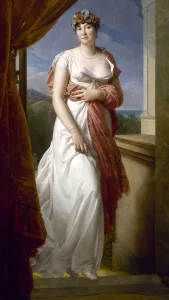
During the Terror, she was imprisoned, tortured, and prepared for execution. Her hair was brutally shorn — a final humiliation meant to mark her as already half-dead. But when she was freed after Thermidor, she did something radical:
She kept it short.
She refused wigs. Refused artifice. Refused to pretend she hadn’t survived hell.
Her cropped hair became a sensation. Women across Paris cut their hair in solidarity, calling it the coiffure à la victime — the victim’s cut. Terézia turned trauma into trend, shame into spectacle, constraint into liberation.
And she didn’t stop there. She married a prince, yes — but she never surrendered her independence. She moved through salons and political circles with a kind of fearless softness, wearing gowns so sheer they caught the light like water.
She wasn’t just unbound. She was unbreakable.
Josephine Bonaparte: The Breeze That Softened an Empire
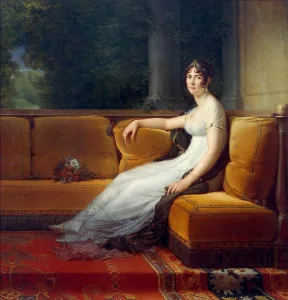
Josephine’s story has always lived in my bones — maybe because I grew up in Louisiana, where Caribbean histories echo through the air. She was born on Martinique, far from the gilded halls she would one day inhabit. She understood heat, humidity, and the pleasure of fabrics that moved with the body.
She brought that sensibility to Paris and changed everything.
Josephine popularized the cashmere shawl, a textile that would later become a Cottagecore staple. She draped them over her high‑waisted muslin gowns, creating a silhouette that was both regal and relaxed.
Her influence softened the entire Empire aesthetic:
- airy muslins
- flowing skirts
- tropical colors
- fabrics that breathed
But Josephine’s story is bittersweet. She traded freedom for power — and lost both. Napoleon cast her aside when she could no longer give him an heir. Her two closest friends, Terézia and Juliette, kept their autonomy. Josephine paid for her crown with her independence.
And yet… her aesthetic legacy endures. Every Cottagecore shawl owes her a debt.
Juliette Récamier: The Woman Who Turned Comfort Into Power
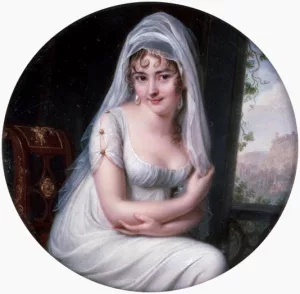
Juliette has always felt like a kindred spirit — the quiet force whose influence is everywhere if you know where to look.
She was the intellectual it‑girl of her time, hosting salons where ideas mattered more than posture. She favored gowns that allowed her to recline, to think, to speak freely. Her signature pose — draped across a chaise longue — became iconic.
The sofa itself was renamed the Récamier, a piece of furniture designed for comfort, conversation, and ease. She left her mark on:
- furniture
- fashion
- politics
- literature
Juliette didn’t just unbind the body. She unbound the mind.
The Equality Link: Softness as Rebellion
Together, these women weren’t just fashion icons. They were architects of a new world.
Their unbound silhouettes — short hair, sheer gowns, cashmere shawls, reclining poses — were political acts in a society rebuilding itself from violence and hierarchy. They used softness as a weapon, comfort as a declaration, beauty as a form of resistance.
And this is where the Cottagecore meaning loops back in:
When society becomes too rigid, too violent, too performative, women lead the way back to breathability.
The Merveilleuses didn’t just change fashion. They changed the emotional vocabulary of liberation.
The 1920s & 1960s: Echoes of the Great Unbinding
History doesn’t repeat itself, but it does rhyme — and after the Merveilleuses shattered the old silhouette, the next great echoes arrived in the 20th century.
The 1920s: The First Modern Unbinding
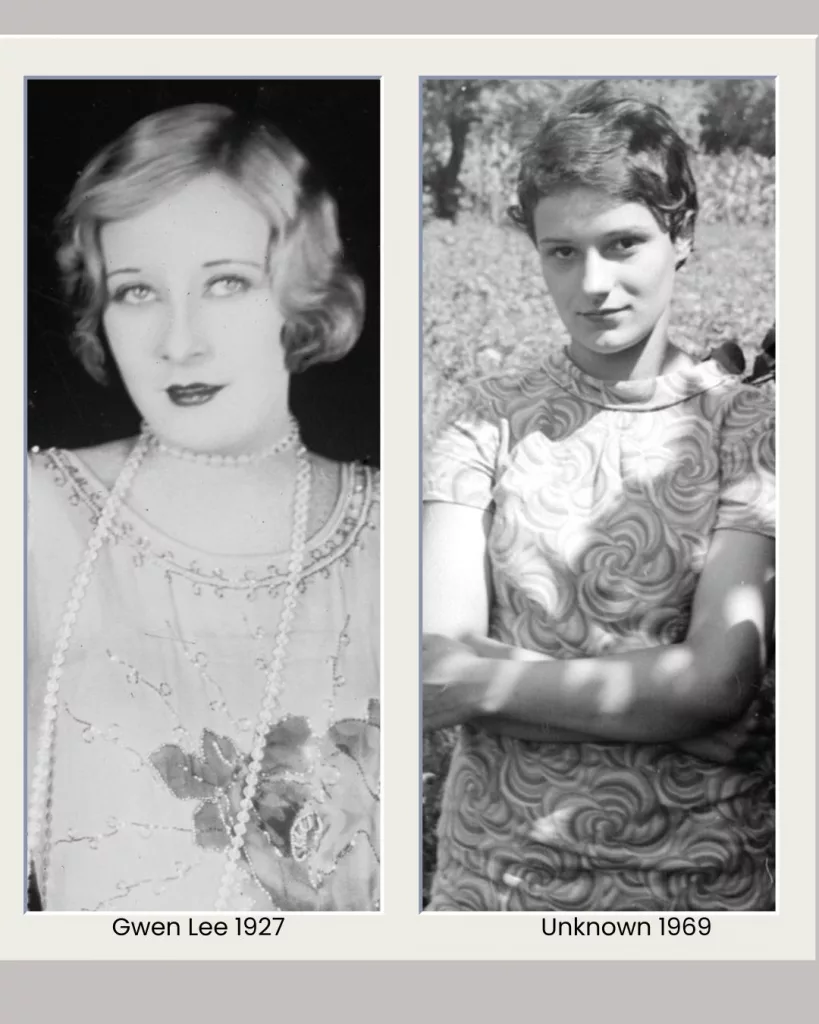
After the trauma of World War I, women once again turned toward liberation through the body. The parallels to the 1790s are uncanny:
- Hair was cut short into the bob, a direct descendant of the coiffure à la victime.
- Corsets were abandoned.
- Silhouettes dropped and loosened.
- Fabrics became lighter, easier, more breathable.
- The body moved — really moved — for the first time in centuries.
The flapper wasn’t just a party girl. She was a survivor reclaiming her body after global violence.
It was another unbinding — a quieter one than the 1960s, but unmistakable.
The 1960s: The Second Great Unbinding
By the mid‑century, the pressure had built again. Two world wars, a global depression, and the suffocating domestic performance of the 1950s had tightened the cultural corset once more.
And once again, people snapped.
Hemlines rose. Waistlines dropped. Bras were symbolically burned.
And hair — oh, the hair — became its own rebellion.
Some grew it long and wild, letting it spill past shoulders in a soft refusal of post‑war neatness. Others chopped it short and shaggy, echoing the liberated silhouette of the coiffure à la victime nearly two centuries earlier. Whether flowing or cropped, the message was the same:
The body will not be disciplined anymore.
But here’s the irony I love most:
While women were unbinding themselves, the home was getting fussier.
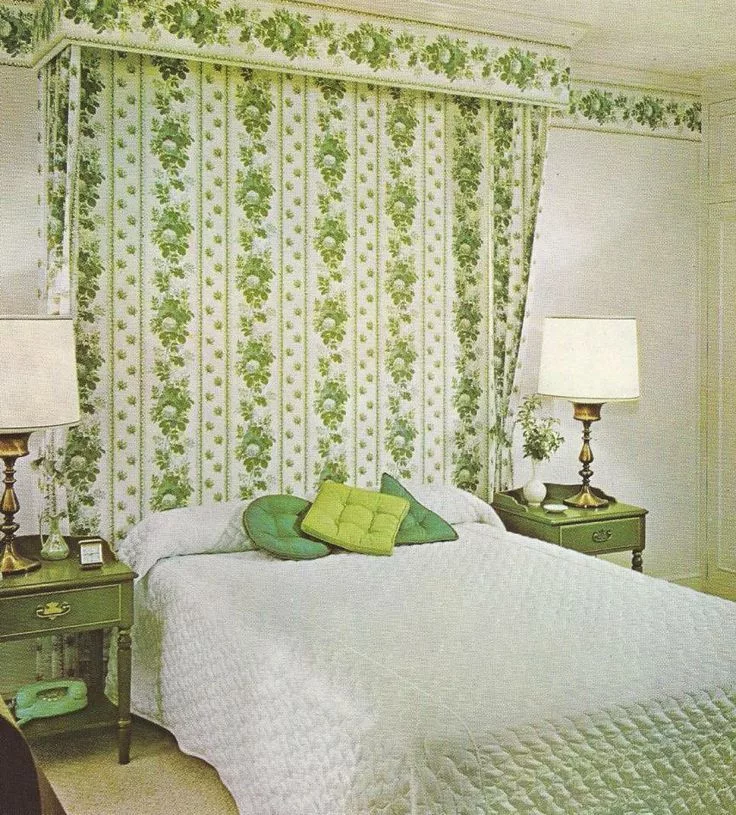
If you look at mid‑century interiors — especially in British mysteries like Miss Marple or Endeavour — you’ll see a return to Rococo‑adjacent domesticity:
- floral chintz
- ruffled curtains
- wallpaper layered upon wallpaper
- decorative clutter
- porcelain figurines
- lace doilies everywhere
The house tightened while the woman loosened.
It’s the same tension we saw in the 18th century: the more ornate the environment becomes, the more the body seeks simplicity.
And this is where the Cottagecore meaning loops back in again. Because Cottagecore isn’t just about nostalgia — it’s about relief. It’s about the body remembering what it feels like to breathe.
The 1920s were the first modern unbinding.
The 1960s were the second.
2026 is the third.
The 2026 Unbinding: Softness in an Age of Collapse
If the 1790s, the 1920s, and the 1960s were unbindings born from trauma, then 2026 is the moment where all those pressures converge at once.
We are living in a world that feels stretched thin — politically, economically, environmentally, spiritually. The air hums with uncertainty. Every institution feels brittle. Every system feels strained. The future feels like something we can’t quite see, can’t quite trust, can’t quite plan for.
And when the world becomes this unstable, the body remembers what to do.
It unbinds.
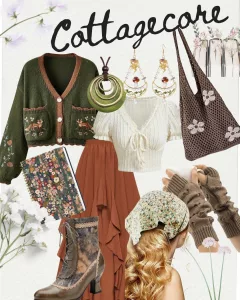
Cottagecore meaning in 2026 isn’t just about pretty dresses or pastoral fantasies. It’s a survival instinct. A cultural exhale. A collective attempt to soften in a world that keeps hardening around us.
Because look at what we’re facing:
- Political landscapes that feel increasingly volatile
- Climate change reshaping the literal ground beneath us
- Financial instability that makes the future feel abstract
- Extreme inequality that stretches society to its breaking point
- Digital burnout that leaves our nervous systems frayed
- A loneliness epidemic in a world more connected than ever
We are living through a pressure cooker of overlapping crises. And just like in 1783, 1795, 1925, and 1968 — the response is the same:
We turn toward softness. We turn toward nature. We turn toward each other. We turn toward breathability.
Cottagecore isn’t escapism. It’s a pressure valve.
It’s the body saying: If the world is going to be this loud, I need a place that’s quiet. If the world is going to be this fast, I need a rhythm that’s slow. If the world is going to be this uncertain, I need something that feels like home.
And that’s why Cottagecore has evolved into something darker, stranger, more complex — Whimsigoth, Fairy Goth, Witchy Pastoral, Cozy‑Chaotic. These aren’t just aesthetics. They’re emotional architectures. They’re ways of building softness with edges, comfort with shadows, beauty with teeth.
Because softness in 2026 isn’t naïve. It’s strategic. It’s adaptive. It’s ancestral.
It’s the same instinct that led Marie Antoinette to the Hameau, that led Terézia to keep her shorn hair, that led Josephine to drape herself in breathable muslin, that led Juliette to recline on her sofa, that led flappers to bob their hair, that led the Youthquake to burn their bras.
When the world becomes too rigid, too violent, too uncertain, we unbind.
Cottagecore is simply the latest expression of that ancient cycle — a soft rebellion in a hardening world.
So What Is Cottagecore? (And What Makes It Different?)
After all this history — the unbindings, the rebellions, the cycles of softness returning after eras of pressure — it’s fair for a reader to ask:
What does Cottagecore actually mean? What makes something Cottagecore instead of Fairycore, Whimsigoth, Dark Academia, or any of the other aesthetics floating around?
The answer is simple, but it’s also deeper than most people realize.
Cottagecore is defined by three core impulses:
🌿 1. A Return to the Natural World
Cottagecore is always rooted in nature — not fantasy nature, not gothic nature, not surreal nature. Just… nature.
- gardens
- forests
- fields
- herbs
- flowers
- weathered wood
- sunlight through leaves
If the aesthetic doesn’t feel grounded in the earth, it’s not Cottagecore.
This is what separates it from Fairycore (which is magical), Whimsigoth (which is mystical), and Dark Academia (which is intellectual).
Cottagecore is the aesthetic of touching the ground again.
🍞 2. A Celebration of the Handmade and the Slow
Cottagecore is obsessed with the tactile, the crafted, the domestic, the unhurried.
- baking bread
- mending clothes
- knitting, crocheting, quilting
- gardening
- writing letters
- tending a home
It’s not about perfection — it’s about process. It’s the opposite of hustle culture.
This is what separates it from Clean Girl, Minimalism, or anything sleek and optimized.
Cottagecore is the aesthetic of slowness as rebellion.
🌸 3. Softness as a Form of Survival
This is the heart of the Great Unbinding.
Cottagecore rises when the world becomes too sharp, too fast, too uncertain. It’s not naïve softness — it’s strategic softness.
- cozy fabrics
- gentle silhouettes
- warm light
- safe spaces
- emotional refuge
This is what separates it from Whimsigoth (softness with shadows), Fairy Goth (softness with edge), or Cozy‑Chaotic (softness with clutter).
Cottagecore is the aesthetic of softness as a shield.
So How Do You Know If Something Is Cottagecore?
Here’s the simplest test:
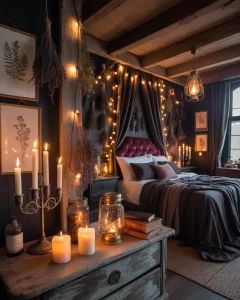
If it feels like a breath, it’s Cottagecore.
If it feels like a spell, it’s Fairycore.
If it feels like a dream, it’s Fairycore.
If it feels like a memory, it’s Vintage.
If it feels like a poem, it’s Dark Academia.
If it feels like a candlelit séance, it’s Whimsigoth.
If it feels like a sanctuary, it’s Cottagecore.
And when you mix them — the softness, the shadows, the magic, the memory — you get Dark Cottagecore, the place where the Great Unbinding grows roots in the underworld and still finds a way to bloom.
Conclusion: The Meaning of Cottagecore in an Unbound Age
Cottagecore isn’t just an aesthetic. It’s the latest chapter in a centuries‑long story about what people do when the world becomes too heavy, too fast, too uncertain.
In the 1790s, women unbound themselves after the Terror. In the 1920s, they unbound themselves after World War I. In the 1960s, they unbound themselves after decades of domestic rigidity. And in 2026, we are unbinding ourselves again — from digital burnout, political volatility, climate anxiety, financial instability, and the relentless pressure to perform.
Cottagecore rises in these moments not because we want to escape reality, but because we want to survive it. It’s softness as strategy. Slowness as rebellion. Nature as medicine. Home as sanctuary.
It’s the body remembering how to breathe.
And when you understand Cottagecore through the lens of the Great Unbindings, it stops being “just a vibe” and becomes something much deeper — a cultural pulse, a historical echo, a collective instinct toward gentleness in an age that keeps demanding hardness.
Cottagecore is what happens when we choose tenderness anyway.
📌 Pin It
Further Reading
A short, curated, fashion‑history‑focused guide for understanding the meaning of Cottagecore
If you’d like to explore the deeper cultural forces behind Cottagecore — the cycles of unbinding, the politics of softness, the history of domesticity, and the silhouettes that shaped our emotional world — these books offer a perfect starting point.
• Queen of Fashion: What Marie Antoinette Wore to the Revolution by Caroline Weber
A brilliant, deeply researched exploration of how clothing became political — and how Marie Antoinette used fashion as both armor and rebellion. Essential for understanding the first Great Unbinding and the roots of Cottagecore’s pastoral longing.
• Liberty, Equality, Fashion: The Women Who Styled the French Revolution by Anne Higonnet
A vivid, accessible look at the Merveilleuses — Terézia Tallien, Josephine Bonaparte, Juliette Récamier — and how they used softness, transparency, and ease to reshape post‑Revolution France. This is the heart of your essay’s historical arc.
• The Age of Homespun by Laurel Thatcher Ulrich
A beautifully researched history of handmade domestic life in early America. If Cottagecore has a textile ancestor, this is it — a study of craft as identity, labor, and quiet rebellion.
• The Golden Thread: How Fabric Changed History by Kassia St. Clair
A sweeping, accessible history of textiles — from muslin to wool to silk — that helps readers understand why breathable fabrics, handmade materials, and tactile domesticity feel so emotionally charged today.
• Fashioning the Feminine: Representation and Women’s Fashion in the Early Modern Period (various authors)
A concise academic introduction to how silhouettes, softness, and domestic imagery have been used to shape — and resist — power. Ideal for readers curious about the political history behind the Great Unbindings.
Related Posts You Might Enjoy
If you’d like to explore more of the themes woven through this essay — softness, domesticity, witchy coziness, and the aesthetics of comfort — here are a few posts from my blog that pair beautifully with this one:
• How to Create a Witchy Room Aesthetic on a Budget
A practical guide to building a cozy, magical sanctuary that feels lived‑in, warm, and deeply personal.
• Witchy Room Decor at Walmart: 30+ Dark Cottagecore Finds
Affordable, atmospheric pieces that bring a little enchantment into everyday spaces.
• 15 Dark Cottagecore Crochet Patterns That Feel Like Pure Witchcraft
For the makers, the stitchers, the crafters — patterns that blend softness with shadow.
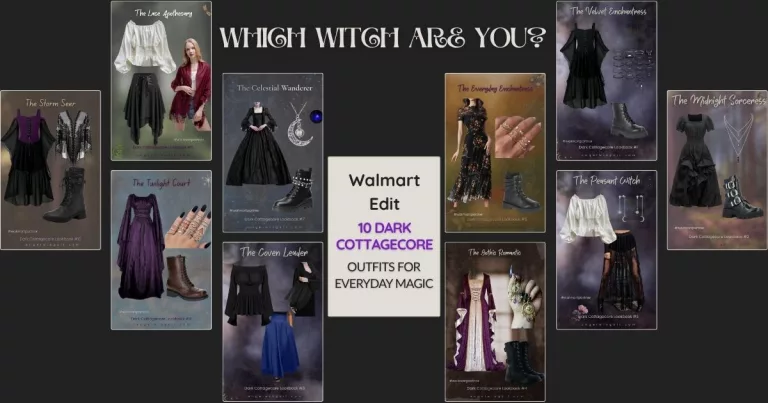
• 15 Dark Cottagecore Outfits for Everyday Magic
A wearable guide to the softer, moodier side of Cottagecore.